Heavy duty crane arrives in Baltimore to help clear debris following deadly bridge collapse

Source: WPVI
Embargo: Philadelphia, PA
Footage Type: PACKAGE
TRT: 01:33


Heavy duty crane arrives in Baltimore to help clear debris following deadly bridge collapse
Source: WPVI
Embargo: Philadelphia, PA
Footage Type: PACKAGE
TRT: 01:33

Americans spend more than $70 billion on lottery tickets each year, but do you know what your options are if you win?

Source: CNN Embargo: NONE TRT: 01:22
Originally Published: 27 MAR 24 03:03 ET
Updated: 27 MAR 24 03:27 ET
By Dalia Faheid, CNN
(CNN) — What would be the fifth-largest jackpot in Powerball history – an estimated $865 million – is up for grabs Wednesday night, a day after a ticket in New Jersey won a Mega Millions grand prize worth more than $1 billion.
The Powerball jackpot in play Wednesday jumped from $800 million after no tickets matched all six numbers in Monday night’s drawing. A jackpot winner in Wednesday’s drawing could choose to receive the money in annuitized payments or take a lump sum estimated at $416.1 million.
The drawing will come a day after Tuesday’s momentous Mega Millions prize. Tuesday’s estimated $1.13 billion Mega Millions jackpot was won by a ticket sold in the Garden State, lottery officials said without immediately saying where in New Jersey the ticket was sold.
The winning Mega Millions numbers Tuesday were: 7, 11, 22, 29, 38 and Mega Ball 4.
The $1.13 billion Mega Millions jackpot, if confirmed at that level, would be rank fifth in that game’s history. The holder could opt for the full jackpot in annual payments or take an estimated $537.5 million lump-sum payment, the lottery has said.
This is the second Powerball jackpot to surpass $800 million this year. The Powerball grand prize was last won in January, when a ticket in Michigan scored a prize worth $842.4 million. Since then, 36 consecutive drawings have taken place without a jackpot winner, according to Powerball.
The largest Powerball jackpot prize – and the largest US lottery prize – ever won was $2.04 billion by a ticket purchased in California in November 2022, according to the lottery.
Wednesday’s estimated $865 million jackpot would rank fifth on Powerball’s all-time list. Ranking second through fourth are $1.765 billion (one ticket in California; 2023); $1.586 billion (three tickets; 2016); and $1.08 billion (one ticket in California, 2023).
Winning the Powerball jackpot means a ticket matched all five white balls plus the red Powerball. The odds of winning any prize in a Powerball drawing are 1 in 24.9, and the odds of winning the jackpot are 1 in 292.2 million, according to the lottery.
Powerball tickets cost $2 per play and are sold in 45 states, the District of Columbia, Puerto Rico and the US Virgin Islands. Drawings are held Mondays, Wednesdays and Saturdays at 10:59 p.m. ET in Tallahassee, Florida.
The-CNN-Wire
™ & © 2024 Cable News Network, Inc., a Warner Bros. Discovery Company. All rights reserved.

**This image is for use with this specific article only** An estimated $865 million is up for grabs Wednesday night.
Nathan Howard/Reuters via CNN Newsource
27 Mar 24

Originally Published: 27 MAR 24 08:30 ET
Updated: 27 MAR 24 09:38 ET
By Christian Edwards, CNN
(CNN) — More than 1 billion meals are wasted across the world each day while nearly 800 million people go hungry, a new United Nations report has found.
The world wasted 1.05 billion metric tons of food in 2022, meaning about a fifth of the food available to people was squandered by households, restaurants and other parts of the food service and retail sectors.
This is on top of the 13% of the world’s food lost as it makes its journey from farm to fork. In total, about a third of all food goes to waste during the production process.
These waste figures are particularly stark when contrasted with the report’s findings that about a third of the world’s population faces food insecurity and 783 million are affected by hunger.
The staggering statistics, published Wednesday in the UN Environment Programme (UNEP) Food Waste Index Report 2024, raise questions about the world’s ability to distribute the food it produces and highlights the role of food waste as a driver of climate change, according to UNEP Director Inger Andersen.
“Food waste is a global tragedy. Millions will go hungry today as food is wasted across the world,” Andersen said. “Not only is this a major development issue, but the impacts of such unnecessary waste are causing substantial costs to the climate and nature.”
The report distinguished between food “loss” — food discarded early in the supply chain, for instance vegetables that rot in fields and meat that spoils when unrefrigerated — and food “waste,” food thrown out by households, restaurants and stores.
Households wasted 631 million metric tons of food in 2022 — 60% of the total — while the food service sector accounted for 28% of the waste and retail 12%.
The average person wastes 79 kilograms (174 pounds)of food each year, meaning at least one billion meals of edible food are wasted in households each day, the report found.
Even these estimates are conservative, according to the report. While data collection has improved — with the number of data points at the household level almost doubling since the UN’s 2021 food waste report — it criticized countries for patchy monitoring.
Just 21 countries have included food loss and waste in their national climate plans, it said, despite the fact that it generates 8% to 10% of global planet-heatingemissions – almost five times more than emissions from the aviation sector.
While the climate impact of gas-guzzling flights has been well covered, the report suggested the impact of the more mundane issue of food waste has been overlooked.
Food is resource-intensive to produce, requiring huge amounts of land and water, and food systems are responsible for about a third of global planet-heating emissions.
The vast majority of food waste goes to landfill, generating methane as it breaks down. A potent greenhouse gas, methane has about 80 times the warming power of carbon dioxide over the first 20 years.
Food waste not only fuels climate change but may be exacerbated by it, the report said. Hotter countries were found to waste more food than cooler ones, as higher temperatures make it more challenging to store and transport food before it spoils.
The report also said food waste is not just a “rich world” phenomenon. The amount of food wasted in high- and middle-income countries differed by just 7 kilograms (15 pounds) per person each year.
The-CNN-Wire
™ & © 2024 Cable News Network, Inc., a Warner Bros. Discovery Company. All rights reserved.

**This image is for use with this specific article only** Food waste spills across a street in London.
Richard Baker/In Pictures/Getty Images via CNN Newsource
27 Mar 24

**This image is for use with this specific article only** A box of frozen lobster tails is discarded with other food scraps in San Francisco, in 2022.
Brittany Hosea-Small/Reuters via CNN Newsource
27 Mar 24

Originally Published: 26 MAR 24 14:13 ET
Updated: 27 MAR 24 09:07 ET
By Mindy Weisberger, CNN
Editor’s note: Sign up for CNN’s Wonder Theory science newsletter. Explore the universe with news on fascinating discoveries, scientific advancements and more.
(CNN) — Picture a dolphin. Now imagine one that’s twice the size of a person.
Around 16 million years ago, a dolphin giant cruised the depths of its watery domain. But unlike most modern dolphins, its home wasn’t an ocean; it lived in a freshwater lake in the Peruvian Amazon. And though there are Amazonian freshwater dolphin species alive today, they aren’t close kin to that ancient cetacean. Its closest living relatives are river dolphins living more than 6,000 miles (10,000 kilometers) away in South Asia, according to researchers who recently described the previously unknown extinct mammal.
Analysis of the newly identified ancient dolphin’s skull told paleontologists that its body would have measured at least 11 feet (3.5 meters) long — making it about 20% to 25% bigger than modern river dolphins and the biggest known freshwater dolphin.
But the skull, which measured about 27 inches (70 centimeters) long, was incomplete, so the ancient dolphin may have been even larger than that, the scientists reported March 20 in the journal Science Advances, published by the American Association for the Advancement of Science.
What makes the find even more exceptional is the insight it offers into the evolutionary history of freshwater dolphins, as these creatures are extremely rare in the fossil record, the study authors wrote. This is because there tend to be fewer individual dolphins in freshwater ecosystems, and strong water currents typically prevent fossils from preserving well.
They called the newfound species Pebanista yacuruna; the genus references Peru’s Pebas Formation, where the fossil was found, and “yacuruna” is a term for mythical aquatic people of local legend, in the Indigenous Kichua language.
“I think this is a remarkable discovery, particularly given that South America has one species of river dolphin that belongs to a completely different group of odontocetes (toothed whales),” said Jorge Velez-Juarbe, an associate curator of marine mammals at the Natural History Museum of Los Angeles County, in an email.
“(It) makes me wonder too how many other records of extinct river dolphins are awaiting to be discovered,” Velez-Juarbe, who was not involved in the research, told CNN.
Modern freshwater dolphins are known for their highly elongated noses, compared with marine dolphins’ stubbier snouts. There’s the South Asian river dolphin (Platanista genus) and the Amazon river dolphin (Inia genus), also known as the pink river dolphin, and the two groups include several species and subspecies.
China’s Yangtze river dolphin (Lipotes vexillifer) represents a third genus, but the species hasn’t been seen in the wild in 40 years and may be extinct, according to the International Union for the Conservation of Nature (IUCN). In fact, all extant river dolphin species are endangered or critically endangered, the IUCN says.
Researchers discovered the Amazonian dolphin fossil in 2018, near the Napo River in Loreto, Peru. Lead study author Aldo Benites-Palomino, a doctoral candidate in the University of Zurich’s Department of Paleontology, had stopped to examine some strange-looking rocky fragments on the ground, he told CNN. At the same time, study coauthor John J. Flynn, a curator of fossil mammals at the American Museum of Natural History in New York City, pointed out what looked like a skull jutting from an embankment.
“I said: ‘Hey, John, does this connect to this piece that I have in my hand?’” Benites-Palomino recalled. What he held turned out to be a rostrum — the rounded tip of a nose — from the embedded skull. As they cleaned it up enough to see the shapes of tooth sockets, Benites-Palomino realized that they were looking at something unusual.
“We started screaming: ‘It’s a dolphin! It’s a dolphin!’” Benites-Palomino said.
At first, they thought it would turn out to be an ancient relative of modern Amazonian river dolphins. But further cleaning revealed that the size and shape of the eye socket resembled that of South Asian river dolphins, which have much smaller eyes than their South American cousins.
“That was a moment where everybody freaked out, because it wasn’t an Amazonian river dolphin,” Benites-Palomino said. This told the scientists that two types of dolphins had independently and at different times moved inland in the region.
Platanistoids — the group that includes P. yacuruna and South Asia’s modern river dolphins — were widespread about 20 million years ago. The ancestors of modern Amazonian river dolphins were common in oceans about 10 million to 6 million years ago, Benites-Palomino said.
Because both groups of cetaceans were so diverse, some species likely ventured into river and lake ecosystems, seeking less competition for food. This Amazonian freshwater environment was nutrient-rich and teeming with life, home to crocodilians, turtles and fish, as well as mammals such as sloths, rodents, ungulates and primates.
“Overall, in these ecosystems ‘river dolphins’ can be considered as apex predators,” Velez-Juarbe said.
P. yacuruna was among the first wave of dolphins to test the waters in Amazonian rivers and lakes; a lack of predators in its new home could explain how the species evolved to become so large, according to the study. But environmental changes like drought may have later doomed P. yacuruna and driven it to extinction, opening the freshwater habitat to the ancestors of extant pink river dolphins.
“We now know that this species was living there in the past, but also the Amazonia is important for our extant Inia geoffrensis,” Benites-Palomino said. “[The discovery] highlights that this is a tremendously important environment for the evolution of freshwater cetaceans.”
P. yacuruna’s disappearance is a grim reminder that this important environment is all too easily disrupted. Today, modern Amazonian river dolphins face an uncertain future, mostly due to mercury pollution from gold mining invading the food chain, according to the World Wildlife Fund. The newfound fossil hints at the fragility of freshwater ecosystems and the vulnerability of their inhabitants — past and present — to environmental changes, whether such changes are natural or human-made, Velez-Juarbe added.
“Pebanista adds another layer to the intricate evolutionary history of cetaceans and particularly ‘river dolphins,’ the few species that survive to present day are but the last remnants of groups that were once more diverse.”
Mindy Weisberger is a science writer and media producer whose work has appeared in Live Science, Scientific American and How It Works magazine.
The-CNN-Wire
™ & © 2024 Cable News Network, Inc., a Warner Bros. Discovery Company. All rights reserved.

**This image is for use with this specific article only** An artistic reconstruction depicts Pebanista yacuruna in the murky waters of the Peruvian proto-Amazonia.
Jaime Bran via CNN Newsource
26 Mar 24

**This image is for use with this specific article only** An international team of researchers discovered the fossil during a 2018 expedition to the Napo river in Peru.
Aldo Benites-Palomino via CNN Newsource
26 Mar 24

**This image is for use with this specific article only** Paleontologist Aldo Benites-Palomino prepares the Pebanista yacuruna holotype skull at the Natural History Museum of Lima in 2018.
Rodolfo Salas-Gismondi via CNN Newsource
26 Mar 24

**This image is for use with this specific article only** Type specimen (holotype) of Pebanista yacuruna, including a photo of the specimen and a surface 3D model in dorsal view.
Aldo Benites-Palomino via CNN Newsource
26 Mar 24
Originally Published: 27 MAR 24 09:49 ET
By Alex Marquardt and Jeremy Diamond, CNN
(CNN) — Talks over a hostage deal and a ceasefire in Gaza between Israel and Hamas have reached another stalemate but are not over, according to three people familiar with the negotiations.
A diplomat described the talks as “stuck but ongoing,” saying that there continues to be “proposals going back and forth.” A second source confirmed the parties are still engaged but said the negotiations are in a “pause.”
There was no breakthrough after CIA Director Bill Burns traveled to Doha late last week to meet with Israeli, Egyptian and Qatari counterparts. Burns put forward a proposal that was accepted by Israel and sent back to Hamas, the second person and an Israeli official told CNN.
On Tuesday morning, Israel was informed that proposal was rejected by Hamas, the Israeli official said, and Israel decided to pull back the team of negotiators that had remained in Doha after Burns and Israel’s Mossad chief, David Barnea, had left Qatar.
“The negotiations are not only centric around the prisoner exchange deal,” Hamas senior official Basem Naeim told CNN on Monday. “Israel has not agreed to any of (Hamas) requests related to a complete ceasefire, the withdrawal of all forces from the Gaza Strip, even in stages, and the return of all displaced people to their homes.”
In the latest talks, Israel had agreed to release around 700 Palestinian prisoners – including many with life sentences – in exchange for 40 Israeli hostages held in Gaza, the Israeli official and the source familiar with the discussions said. Those releases would take place during the first phase of a ceasefire, which would be expected to last around six weeks.
But other major discussion points – for just the first phase – are still being fiercely debated: the ability for Gazans in the south to return home to the north, a surge of humanitarian aid for Gaza and the locations of Israeli troops.
Hamas has regularly taken a more maximalist approach to what is expected to be a three-phase deal: demanding eventual discussions on an end to the war and the full withdrawal of IDF troops from Gaza. Israel has refused to engage on either point, insisting on the need to continue efforts to dismantle Hamas.
The Israeli official said that Hamas didn’t counter their latest proposal that around 2,000 Palestinians be allowed to go back to the north per day, instead saying all the displaced Gazans should be allowed to return. Hamas again argued all IDF troops should leave Gaza, including from the new checkpoint road Israel has built that cuts across the middle of the enclave.
The National Security Council declined a request for comment Wednesday.
American officials have said this week that progress was made during the weekend talks in Doha. The process is complex and slow, one US official argued, in part because the Hamas negotiators need to get responses from the head of the group in Gaza, Yahya Sinwar, who is believed to be somewhere in the vast underground tunnel system.
On Tuesday, State Department Spokesman Matthew Miller criticized the argument by Israeli Prime Minister Benjamin Netanyahu’s office that Hamas rejected the American ceasefire proposal in light of the United Nations Security Council’s passage of a resolution calling for an immediate ceasefire, which the US did not veto.
“That statement is inaccurate in almost every respect, and it is unfair to the hostages and their families,” Miller said.
The inability to achieve a ceasefire could accelerate Israel’s plans to launch a largescale ground offensive into the southern Gaza city of Rafah. The US has repeatedly warned Israel against an operation without a coherent plan for the safety of the 1.4 million Palestinians sheltering there, which the Biden administration says it has not heard.
Israel’s defense minister, Yoav Gallant, visited Washington this week for a whirlwind series of meetings with top Biden national security officials, including an unannounced meeting with the CIA director on Tuesday night.
The senior US officials and Gallant did not reach any agreements on how Israel will move forward with an operation in Rafah in southern Gaza, US and Israeli officials told CNN.
Gallant was told that Israel needs to find an “alternative” option to a major assault of Rafah. Israeli officials said Gallant was open to the US’ recommendations about how to proceed with an attack on Hamas in Rafah, but ultimately Israeli officials said they will execute the plan they think is necessary to eliminate the remaining five Hamas battalions in the area.
CNN’s Natasha Bertrand contributed to this report.
The-CNN-Wire
™ & © 2024 Cable News Network, Inc., a Warner Bros. Discovery Company. All rights reserved.

**This image is for use with this specific article only** A man passes by a building covered with photos of hostages who have been released or are still being held in the Gaza Strip, on March 26, in Tel Aviv, Israel.
Amir Levy/Getty Images via CNN Newsource
27 Mar 24

**This image is for use with this specific article only** Smoke plumes billow after Israeli bombardment over Rafah in the southern Gaza Strip on March 20, amid ongoing battles between Israel and the Palestinian militant group Hamas.
Said Khatib/AFP via Getty Images via CNN Newsource
27 Mar 24

**This image is for use with this specific article only** Central Intelligence Agency Director William Burns listens during a hearing with the House Intelligence Committee in the Cannon Office Building on March 12, in Washington, DC.
Anna Moneymaker/Getty Images via CNN Newsource
27 Mar 24

Originally Published: 27 MAR 24 10:20 ET
By Web staff
Click here for updates on this story
VANCOUVER, Washington (KPTV) — A child has been hospitalized after they were involved in a crash with a school bus in Vancouver early Tuesday morning.
Just after 7:15 a.m., Vancouver Fire Department crews were called out to a crash at Southeast Ellsworth Road and Southeast 10th Street involving a school bus and a child on a bike.
Officials say crews found a 9-year-old boy entangled in his bike under the rear axle of the bus. Crews used specialized tools to lift the bus and remove the boy from underneath.
The child was taken to a Portland area pediatric hospital with non-life-threatening injuries.
Vancouver police say an investigation showed the bus was making an eastbound turn onto SE 10th Street from SE Ellsworth on a green light when two bicyclists entered the roadway. The first bicyclist crossed the road in front of the bus as it was making the turn. The second bicyclist, the 9-year-old boy, tried to cross but hit the side of the bus and went underneath.
The bus driver was not cited and was not found to be at fault, according to police.
Evergreen Public Schools says the child is a student at Ellsworth Elementary. The district also says the school bus had one high school student on it at the time, but they were not hurt.
Please note: This content carries a strict local market embargo. If you share the same market as the contributor of this article, you may not use it on any platform.
The-CNN-Wire
™ & © 2024 Cable News Network, Inc., a Warner Bros. Discovery Company. All rights reserved.

Embargo: Portland, OR; **This image is for use with this specific article only** Vancouver, Washington firefighters rescued a child on a bike pinned under a school bus.
Vancouver Fire Department/KPTV via CNN Newsource
27 Mar 24
Originally Published: 27 MAR 24 07:30 ET
Updated: 27 MAR 24 10:32 ET
By Nathaniel Meyersohn, CNN
New York (CNN) — Inflation has touched nearly everything these last few years — even Trader Joe’s 19-cent bananas. But Costco is holding the line on its hot dog-soda combo price.
Costco’s hot dog deal, sold at its food courts, is still priced at $1.50 — exactly what it cost in 1985, before the Great Recession, the housing crisis, the pandemic and the latest bout of decades-high inflation.
Since the pandemic started, prices for consumers have gone up 20% overall, according to the Bureau of Labor Statistics. In many key areas, like housing and groceries, prices have increased even more.
If Costco’s hot dog deal kept pace with inflation, it would be three times as expensive today — nearly $4.50. But Costco’s $1.50 combo is a strategic decision, known as a loss-leader: The company is willing to lose money selling the hot dogs at that price — inflation be darned — so long as it helps Costco draw in and retain customers.
“It’s branding,” said Scott Mushkin, a retail analyst at R5 Capital. The $1.50 deal helps create customer loyalty, he said. “It reminds customers of who Costco is.”
Costco loses money selling more than 100 million hot dogs every year, but the company offsets these losses by raising prices on other goods it sells. Costco has increased prices of pizzas and other items at its food courts.
But Costco has a unique business model that allows it to keep prices low: It makes almost all of its money on memberships, selling items on its warehouse floor very nearly at cost – and sometimes less.
Costco’s longtime finance chief Richard Galanti, who retired this month, said in a recent interview that the $1.50 price was “probably safe for a while.”
Most companies don’t have the luxury of a membership model like Costco. They can’t get by selling most of their items for very little profit — or taking a loss on products they sell 100 million of each year.
Inflation has slowed considerably since it peaked at 9.1% in June of 2022. In its battle to bring down that inflation, the Federal Reserve introduced 11 aggressive rate hikes meant to crush demand and discourage spending.
It’s working — overall consumer prices rose by 3.2% in February, according to the latest data from the Bureau of Labor Statistics.
And while we may wish for lower prices, falling prices would actually serve as a red flag indicating that the economy is in bad shape. We’re not there yet, don’t worry.
Companies have been reporting surprisingly strong earnings in recent months on the back of strong consumer spending. Even though companies – including Costco – have to raise prices (even on hot dogs in some cases), Americans continue to shell out.
Consumer spending is the biggest engine powering the US economy and when people spend a lot less money employers tend to lay off workers, which can lead to even lower spending and even more layoffs. This cycle can throw the economy into a recession. Again, that’s not happening yet.
“The reason prices fall is because people aren’t buying. That means we’d be in a recession,” said Gus Faucher, chief economist at PNC Financial Services.
Costco’s hot dog defied inflation from the very start.
Costco’s hot dog offering was born in the company’s early days. Costco added a Hebrew National stand at its second warehouse store in Portland, Oregon, shortly after it opened in 1983.
To keep the price of the hot dog steady, Costco found ways to slash other costs at the food court, such as switching from 12-ounce soda cans to cheaper, 20-ounce fountain drinks.
Costco sold kosher hot dogs at its food courts until 2009, but suppliers started to run low on meat. Realizing the importance of the low-priced hot dog, the chain brought production in-house and switched to its own Kirkland Signature brand. Costco now produces around 388 million non-kosher hot dogs a year at its plants for both food courts and to sell in packs.
Jim Sinegal, Costco’s co-founder, once told the company’s former CEO Craig Jelinek, “If you raise the effing hot dog, I will kill you. Figure it out.”
“I know it sounds crazy making a big deal about a hot dog, but we spend a lot of time on it,” Sinegal told the Seattle Times in 2009. “We’re known for that hot dog. That’s something you don’t mess with.”
Last year, Costco sold more than 130 million — around $195 million worth — of hot dog-soda combos globally.
The-CNN-Wire
™ & © 2024 Cable News Network, Inc., a Warner Bros. Discovery Company. All rights reserved.
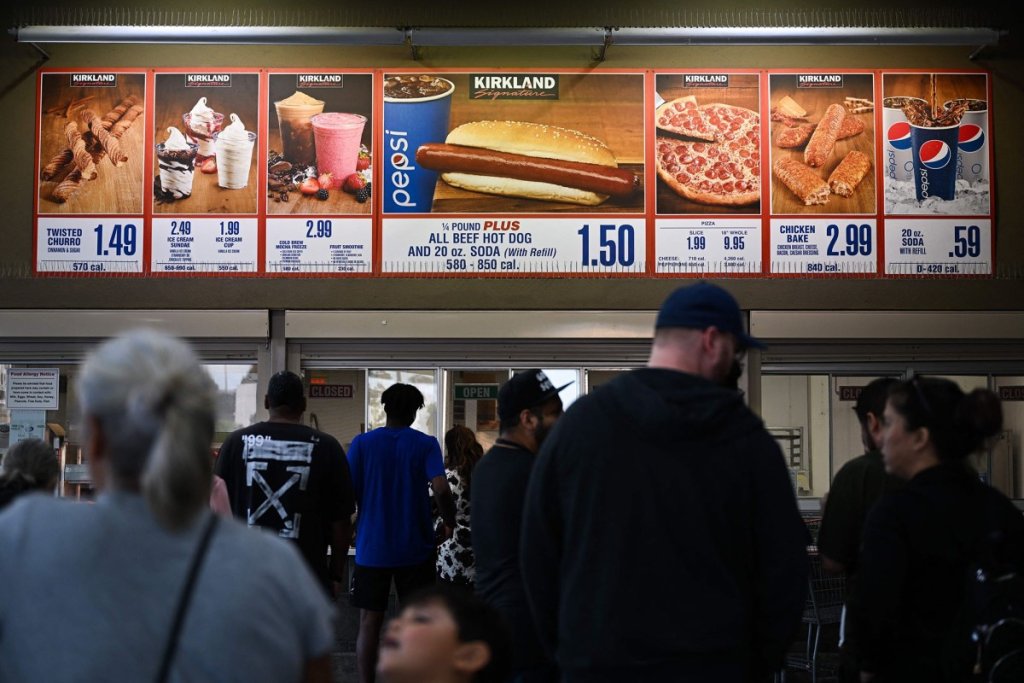
**This image is for use with this specific article only** Costco’s food court and its famous $1.50 hot dog and soda combo meal.
Patrick T. Fallon/AFP/Getty Images via CNN Newsource
27 Mar 24
Six construction workers are presumed dead after a large cargo ship crashed into Francis Scott Key Bridge in Baltimore. CNN’s Gabe Cohen reports on what we know about them.

Source: CNN Embargo: NONE TRT: 01:15
Originally Published: 27 MAR 24 09:24 ET
Updated: 27 MAR 24 10:21 ET
By Holly Yan, Maria Santana and Melissa Alonso, CNN
(CNN) — They worked the overnight shift fixing potholes on a famed bridge that 30,000 Marylanders relied on every day. But their work ended in tragedy Tuesday morning when a 213-million-pound cargo vessel crashed into the bridge, plunging the construction workers into the dangerously cold water below.
After a day-long search, officials called off the rescue mission and said the workers are presumed dead. It was virtually impossible to survive the frigid, 50-foot-deep water after several hours, and it was too dangerous for divers to navigate the dark water amid sharp debris.
Now the families of the six victims are mourning their loved ones, whose bodies have not been found. These are some of their stories:
Maynor Yassir Suazo Sandoval, 38, was one of the construction workers who vanished after the bridge collapse, his brother Martin Suazo told CNN.
Family members in Baltimore called Martin Suazo early Tuesday morning to tell him his brother was missing, Suazo said.
Maynor Suazo was originally from Santa Bárbara in Honduras but moved to the US in search of a better life, his brother said. Maynor had lived in the US for the past 18 years. He was married with two children – an 18-year-old son and a 5-year-old daughter, Martin Suazo said.
In addition to working as a constrution worker, Sandoval was also an entrepreneur who started a maintenance company, his brother said.
Suazo, who lives in Honduras, said his family is grateful for the support they have received from the FBI, the Honduran Embassy in Washington and the governor of Maryland, who has promised to do all he can to find and recover the bodies.
Suazo said his familiy was holding on to hope that his brother would be found alive. But now, they just hope his body can be recovered so they can feel a sense of closure.
Miguel Luna was also on the Francis Scott Key Bridge when it collapsed Tuesday, according to a statement from CASA, a nonprofit that provides critical services to working-class and immigrant families.
“Sadly, we discovered that one of the construction workers involved was a longtime member of our CASA family, adding an even deeper layer of sorrow to this already grievous situation,” CASA Executive Director Gustavo Torres said in the statement.
“Miguel Luna, from El Salvador, left at 6:30 p.m. Monday evening for work and … has not come home. He is a husband, a father of three, and has called Maryland his home for over 19 years,” the statement said.
“The entire Baltimore region and CASA family is lamenting this tragedy,” Torres said. “Our hearts ache for the families of the victims and all those impacted by this horrific accident.”
CNN has tried to reach Luna’s family members for more information.
CASA said it is working to provide humanitarian support as families grapple with the tragedy and seek answers about missing loved ones.
This is a developing story and will be updated.
CNN’s Tina Burnside contributed to this report.
The-CNN-Wire
™ & © 2024 Cable News Network, Inc., a Warner Bros. Discovery Company. All rights reserved.

**This image is for use with this specific article only** A view of the Dali cargo vessel which crashed into the Francis Scott Key Bridge causing it to collapse in Baltimore, Maryland, Tuesday, March 26.
Julia Nikhinson/Reuters via CNN Newsource
27 Mar 24

**This image is for use with this specific article only** Miguel Luna was a husband and father of three.
Obtained by CNN via CNN Newsource
27 Mar 24

**This image is for use with this specific article only** Maynor Yassir Suazo Sandoval is survived by a wife and two children, his brother said.
Martin Suazo via CNN Newsource
27 Mar 24

As a volcano erupts in the Icelandic town of Grindavik, videographers capture the sky breaking out into celestial light.

Source: CNN
Embargo: NONE
TRT: 00:48
Homeland Security agents on Monday raided a Los Angeles home associated with rapper Sean “Diddy” Combs and his production company.

Source: KFSN Embargo: Fresno-Visalia, CA Footage Type: PACKAGE TRT: 01:03